Want to wake up with clear vision instead of searching for your glasses every time your alarm rings? If so, extended wear contact lenses might be the right choice for you.
In general, contact lenses can be categorized into two types, based on how long they are approved to be worn before being removed:
Daily wear (lenses you remove before sleep)
Extended wear (lenses you can wear overnight)
So what’s the difference between daily wear and extended wear lenses?
Most extended wear (EW) contacts are thinner than daily wear soft lenses, or are made of silicone hydrogel material. This advanced lens material enables EW lenses to “breathe” better than regular soft (hydrogel) lenses. This is especially important when lenses are worn continuously for extended periods.
Most extended wear soft contact lenses are approved for up to seven days of continuous wear, depending on your eye care professional’s recommendations. Some EW lenses are approved for up to 30 days of continuous wear.
It’s important to note that these are the maximum recommended wearing schedules. Many people cannot tolerate wearing EW lenses for this length of time, and some people’s eyes cannot tolerate any overnight wear of contact lenses.
During your contact lens fitting and follow-up, your eye doctor will advise you whether you can wear EW contacts overnight and how many days of continuous wear your eyes can tolerate.
Risks of extended wear contacts
Research has shown that the risk of eye infections is higher among people who sleep while wearing contact lenses.
Wearing contact lenses continually (day and night) increases this risk because bacteria and other potentially dangerous microorganisms can adhere to the lenses and get trapped between the lenses and your eyes.
These microbes thrive in the warm, moist environment under your contact lenses, especially when your eyelids are closed during sleep. And because contact lenses reduce the oxygen supply to the front surface of your eyes (corneas), your eyes are less able to fight off corneal infections.
You can order extended wear contact lenses from Eye update Clinic & Optical Supplies by calling: 08107531046 or 08034971582. You can also visit our facility at 01 Ajuwon bus stop off Elliot bus stop Iju Ishaga Ajuwon near Akute Alagbole (Lagos and Ogun residents)
A primer on the use of these therapeutic lenses to serve and protect the corneas of our patients.
By Susan Gromacki, O.D., M.S., F.A.A.O.
The concept of a protective eye bandage originated in the first century A.D., when Celsus reportedly applied a honey-soaked linen to the site of a pterygium removal to prevent symblepharon development.1,2 Bandage soft contact lenses were first used in the 1970s following the development of hydroxyethyl methacrylate (HEMA) by Otto Wichterle.2 With the recent advances in material technology, today’s bandage contact lenses provide the same benefits as their predecessors—but with enhanced convenience, improved healing and increased corneal health.
Bandage Lens Basics By definition, a bandage contact lens protects the cornea. Many different lens types can be utilized to accomplish this goal (see tables 1 and 2); however, because of their high oxygen permeability and FDA approval for extended wear, silicone hydrogel soft contact lenses are currently most practitioners’ first choice.
Bandage lenses protect the cornea not only from potential exterior sources of injury, but also from a patient’s own eyelids. The shearing effect created by the lids during the blink can inhibit re-epithelialization and cause pain. Use of a bandage lens facilitates corneal healing in a pain-free environment.
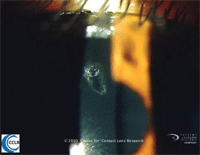
Depending on the patient’s ocular condition, he or she may wear their therapeutic lenses for a period of days to years. They may be utilized for daily or extended wear (see table 2). Because there is generally an underlying disease process precipitating the need for a therapeutic lens, extra caution must be taken to clean and disinfect the lens after wear, keeping in mind that silicone hydrogel lenses tend to deposit lipids more readily than HEMA lenses (see image 1). That said, the addition of a digital rubbing step is necessary for lenses that are used more than once.
It is critical to perform frequent follow-ups for bandage contact lens patients. One reason is that a bandage lens fit, by design, demonstrates less movement than a traditional soft lens fit. The theory is to provide increased patient comfort while preventing the healing epithelial cells from sloughing off due to any mechanical trauma of the lens itself.3 In addition, it is important for the practitioner to be vigilant regarding the detection of signs of microbial keratitis. The compromised cornea—especially when wearing lenses in an extended wear modality—is at particular risk for infection.4
Indications Bandage contact lenses are indicated for many different reasons, including: protecting the eyes, increasing comfort, facilitating healing and sealing wound leaks. We’ll explore these indications, and others, in more detail in the following paragraphs.
• Protection. Corneal protection is needed in the case of several conditions, including: entropion, trichiasis, tarsal scars, recurrent corneal erosion, post-surgical ptosis and surgical sutures or exposed suture knots.
Recurrent erosions are a typical sequella of epithelial basement membrane (basal lamina) trauma or are secondary to anterior basement membrane dystrophy, anterior basement membrane degeneration or stromal dystrophy. A bandage contact lens is the second line of treatment, after hyperosmotic drops and/or ointment fail.2,5 An added benefit is the enhanced vision provided by the smooth refracting surface of the contact lens, as opposed to an irregular anterior corneal surface.5 Hypertonic saline drops should continue to be utilized concurrently with the lenses.
• Pain relief. The mitigation of corneal pain is another important indication for therapeutic contact lenses. The conditions most in need of this therapy include bullous keratopathy; epithelial erosion and abrasion; filamentary keratitis; and postoperative penetrating keratoplasty.
In bullous keratopathy, endothelial failure results in corneal edema, which in turn creates epithelial blisters that rupture, causing pain, foreign body sensation, and photophobia. A bandage contact lens reinforces the damaged tissues and protects the nerve endings from the abrasive actions of the eyelids. Patients who are awaiting a conjunctival flap or cornea transplant may be fitted with therapeutic lenses for up to 30 days at a time.2 Until recently, pressure patching was the standard of care for treating large epithelial abrasions (see figure 2). With this treatment, the caveat was to refrain from patching contact lens wearers or injuries caused by presumed vegetative matter or false fingernails. The utilization of a bandage contact lens provides protection and healing for all three of these conditions, and it has now supplanted patching as the standard of care. The authors of the Wills Eye Manual caution, however, that prophylactic topical antibiotics should be used concurrently and that daily follow-up care is mandatory.6
1. Therapeutic soft contact lens with 2+ surface coating.
The other advantage of bandage contact lenses over patching is the ability to continue to install topical ophthalmic medications. This is particularly important after a corneal abrasion, erosion, or corneal refractive surgery, which necessitate the frequent installation of antibiotics and/or artificial tears. Some reports caution against the installation of cycloplegic agents (which reduce the pain associated with a corneal abrasion/erosion or after corneal refractive surgery) in bandage CL wearers. The dilating drops can cause the bandage lenses to dry out and become less comfortable, especially overnight, with the end result a potentially decreased healing response.7 On the other hand, bandage contact lenses can be utilized—by design—as vehicles for drug delivery, but the exact way to ensure a consistent dosage is still under investigation.
• Healing. The use of bandage contact lenses to facilitate healing is particularly necessary for the following conditions: chronic epithelial defects, corneal ulcer, neurotrophic keratitis, neuroparalytic keratitis, chemical burns and basement membrane disease.
They also enhance healing following corneal surgery, particularly refractive surgery. They protect the cornea from exposure or from the irritation caused by rubbing the eye as the corneal wounds are healing. Therapeutic bandage contact lenses are a mainstay after photorefractive keratectomy (PRK) procedures, in which the removal of the epithelium leaves an open wound that takes about one week to heal (see figure 3). They are also valuable for the following procedures: laser-assisted in situ keratomileusis (LASIK), laser-assisted subepithelial keratomileusis (LASEK), Epi-LASIK, penetrating keratoplasty (PK) and phototherapeutic keratectomy (PTK), lamellar grafts and corneal flaps.
2. The use of therapeutic contact lenses has replaced pressure patching as the standard of care for epithelial abrasions such as the one in the image above.
• Sealing. The lenses also may aid in sealing leaky wounds. Serving as a splint or sealant, the lenses can be beneficial after cataract, penetrating keratoplasty or glaucoma filtering surgery.
• Maintenance of corneal hydration. The role of bandage contact lenses in dry eye is controversial. For patients who need to continually instill lubricating drops into their eyes, particularly after refractive surgery, the benefits of using a bandage lens can be great. Other patients who benefit are those who have significant lagophthalmos and subsequent corneal exposure. However, contact lenses are generally contraindicated for dry eye.7
• Structural stability and protection in piggyback lens fitting. Many patients benefit from the utilization of a soft and rigid lens concurrently. The rigid lens provides crisp vision, particularly for irregular corneas, and the soft bandage lens protects the cornea, preventing irritation and abrasions. Examples include elevation differences in the host/graft junction, keratoconus and in the presence of scar tissue.
Contraindications
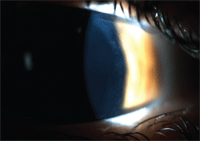
3. The cornea, one day following PRK.
Each clinician must assess his patient’s condition carefully to determine whether a bandage contact lens is warranted. Interestingly, many of the conditions that require bandage contact lenses (dry eye, infection, inflammation, etc.) contraindicate lens wear in general. In addition, therapeutic contact lenses should not be used in patients who are unwilling or unable to comply with the necessary treatment and follow-up.
Dr. Gromacki is a diplomate in the Cornea, Contact Lens and Refractive Technologies Section of the American Academy of Optometry. She is Chief Research Optometrist at Keller Army Community Hospital, West Point, New York.
1. Arrington GE. A history of ophthalmology. MD Publishers, New York, New York, 1959. 2. Weiner BM. Therapeutic bandage lenses. In: Silbert JA, ed. Anterior Segment Complications of Contact Lens Wear. Churchill Livingstone, New York, New York, 1994; 455-471. 3. Aquavella JV. Chronic corneal edema. Am J Ophthalmol 1973;(76):201-207. 4. Thoft RA, Mobilia EF. Complications with therapeutic extended wear soft contact lenses. Int Ophthalmol Clin. 1981;(21):197. 5. Chan WE, Weissman BA. Therapeutic contact lenses. In: Bennett ES, Weismann BA, (eds). Clinical Contact Lens Practice, Lippincott Williams & Wilkins: New York, New York, 2005: 619-628. 6. Ehlers JP and Shah CP, eds. The Wills Eye Manual Fifth Edition, Wolters Kluwer Health, New York, New York, 2008:15-16. 7. Russell GE. Bandage lenses: new opportunities in practice. Contact Lens Spectrum. 2004(6). 8. Tyler Thompson TT. Tyler’s Quarterly 2011;28(3):32-52. 9. White P. 2011 Contact Lenses and Solutions Summary. In: Contact Lens Spectrum (suppl) 2011;27(7):14.
Contact lenses are an excellent choice for nearly anyone who needs vision correction and doesn’t want to wear eyeglasses full time or undergo LASIK surgery.
Unsure about contact lenses? This article will detail contact lens materials, contact lens designs and features and even new contact lens formats.
For instance, the first light-adaptive contact lenses, Acuvue Oasys with Transitions, debuted in the United States in 2019 and contact lenses embedded with antibiotics are in the works. (See our contact lens news page for the latest in contact lenses.)
Here are the basics you should know about contact lenses before seeing your eye doctor if you are interested in wearing contacts.
Contact Lens Materials
The first choice when considering contact lenses is which lens material will best satisfy your needs. There are five types of contact lenses, based on type of lens material they are made of:
Contact Lens Material
Soft lenses are made from gel-like, water-containing plastics called hydrogels. These lenses are very thin and pliable and conform to the front surface of the eye. Introduced in the early 1970s, hydrogel lenses made contact lens wear much more popular because they typically are immediately comfortable. The only alternative at the time was hard contact lenses made of PMMA plastic (see below). PMMA lenses typically took weeks to adapt to and many people couldn’t wear them successfully.
Silicone hydrogel lenses are an advanced type of soft contact lenses that are more porous than regular hydrogel lenses and allow even more oxygen to reach the cornea. Introduced in 2002, silicone hydrogel contact lenses are now the most popular lenses prescribed in the United States.
Gas permeable lenses — also called GP or RGP lenses — are rigid contact lenses that look and feel like PMMA lenses (see below) but are porous and allow oxygen to pass through them. Because they are permeable to oxygen, GP lenses can be fit closer to the eye than PMMA lenses, making them more comfortable than conventional hard lenses. Since their introduction in 1978, gas permeable contact lenses have essentially replaced nonporous PMMA contact lenses. GP contacts often provide sharper vision than soft and silicone hydrogel contacts — especially if you have astigmatism. It usually takes some time for your eyes to adjust to gas permeable lenses when you first start wearing them, but after this initial adaptation period, most people find GP lenses are as comfortable as hydrogel lenses.
Hybrid contact lenses are designed to provide wearing comfort that rivals soft or silicone hydrogel lenses, combined with the crystal-clear optics of gas permeable lenses. Hybrid lenses have a rigid gas permeable central zone, surrounded by a “skirt” of hydrogel or silicone hydrogel material. Despite these features, only a small percentage of people in the U.S. wear hybrid contact lenses, perhaps because these lenses are more difficult to fit and are more expensive to replace than soft and silicone hydrogel lenses.
PMMA lenses are made from a transparent rigid plastic material called polymethyl methacrylate (PMMA), which also is used as a substitute for glass in shatterproof windows and is sold under the trademarks Lucite, Perspex and Plexiglas. PMMA lenses have excellent optics, but they do not transmit oxygen to the eye and can be difficult to adapt to. These (now old-fashioned) “hard contacts” have virtually been replaced by GP lenses and are rarely prescribed today.
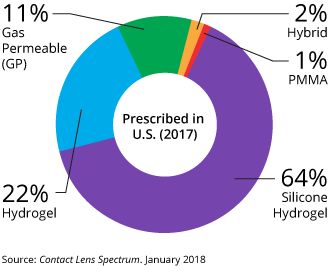
In 2017, 64 percent of contact lenses prescribed in the U.S. were silicone hydrogel lenses, followed by soft (hydrogel) lenses (22 percent), gas permeable lenses (11 percent), hybrid lenses (2 percent) and PMMA lenses (1 percent).
Contact lenses are an excellent choice for nearly anyone who needs vision correction and doesn’t want to wear eyeglasses full time or undergo LASIK surgery.
Unsure about contact lenses? This article will detail contact lens materials, contact lens designs and features and even new contact lens formats.
For instance, the first light-adaptive contact lenses, Acuvue Oasys with Transitions, debuted in the United States in 2019 and contact lenses embedded with antibiotics are in the works. (See our contact lens news page for the latest in contact lenses.)
Here are the basics you should know about contact lenses before seeing your eye doctor if you are interested in wearing contacts.
Contact Lens Materials
The first choice when considering contact lenses is which lens material will best satisfy your needs. There are five types of contact lenses, based on type of lens material they are made of:
Contact Lens Material
Soft lenses are made from gel-like, water-containing plastics called hydrogels. These lenses are very thin and pliable and conform to the front surface of the eye. Introduced in the early 1970s, hydrogel lenses made contact lens wear much more popular because they typically are immediately comfortable. The only alternative at the time was hard contact lenses made of PMMA plastic (see below). PMMA lenses typically took weeks to adapt to and many people couldn’t wear them successfully.
Silicone hydrogel lenses are an advanced type of soft contact lenses that are more porous than regular hydrogel lenses and allow even more oxygen to reach the cornea. Introduced in 2002, silicone hydrogel contact lenses are now the most popular lenses prescribed in the United States.
Gas permeable lenses — also called GP or RGP lenses — are rigid contact lenses that look and feel like PMMA lenses (see below) but are porous and allow oxygen to pass through them. Because they are permeable to oxygen, GP lenses can be fit closer to the eye than PMMA lenses, making them more comfortable than conventional hard lenses. Since their introduction in 1978, gas permeable contact lenses have essentially replaced nonporous PMMA contact lenses. GP contacts often provide sharper vision than soft and silicone hydrogel contacts — especially if you have astigmatism. It usually takes some time for your eyes to adjust to gas permeable lenses when you first start wearing them, but after this initial adaptation period, most people find GP lenses are as comfortable as hydrogel lenses.
Hybrid contact lenses are designed to provide wearing comfort that rivals soft or silicone hydrogel lenses, combined with the crystal-clear optics of gas permeable lenses. Hybrid lenses have a rigid gas permeable central zone, surrounded by a “skirt” of hydrogel or silicone hydrogel material. Despite these features, only a small percentage of people in the U.S. wear hybrid contact lenses, perhaps because these lenses are more difficult to fit and are more expensive to replace than soft and silicone hydrogel lenses.
PMMA lenses are made from a transparent rigid plastic material called polymethyl methacrylate (PMMA), which also is used as a substitute for glass in shatterproof windows and is sold under the trademarks Lucite, Perspex and Plexiglas. PMMA lenses have excellent optics, but they do not transmit oxygen to the eye and can be difficult to adapt to. These (now old-fashioned) “hard contacts” have virtually been replaced by GP lenses and are rarely prescribed today.
In 2017, 64 percent of contact lenses prescribed in the U.S. were silicone hydrogel lenses, followed by soft (hydrogel) lenses (22 percent), gas permeable lenses (11 percent), hybrid lenses (2 percent) and PMMA lenses (1 percent).
Until 1979, everyone who wore contact lenses removed and cleaned them nightly. The introduction of “extended wear” enabled wearers to sleep in their contacts. Now, two types of lenses are classified by wearing time:
Daily wear — must be removed nightly
Extended wear — can be worn overnight, usually for seven days consecutively without removal
“Continuous wear” is a term that’s sometimes used to describe 30 consecutive nights of lens wear — the maximum wearing time approved by the FDA for certain brands of extended wear lenses
When To Replace Your Contact Lenses
Even with proper care, contact lenses (especially soft contacts) should be replaced frequently to prevent the build-up of lens deposits and contamination that increase the risk of eye infections.
Soft lenses have these general classifications, based on how frequently they should be discarded:
Lens Replacement Frequency
Daily disposable lenses — Discard after a single day of wear
Disposable lenses — Discard every two weeks, or sooner
Frequent replacement lenses — Discard monthly or quarterly
Traditional (reusable) lenses — Discard every six months or longer
Gas permeable contact lenses are more resistant to lens deposits and don’t need to be discarded as frequently as soft lenses. Often, GP lenses can last a year or longer before they need to be replaced.
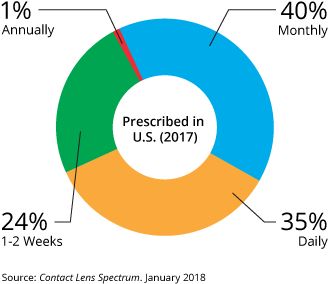
The most frequently prescribed contact lens replacement schedule in the U.S. in 2017 was monthly (40 percent), followed by daily (35 percent), every one to two weeks (24 percent) and annually (1 percent).
Soft contact lenses (both standard hydrogel and silicone hydrogel lenses) are available in a variety of designs, depending on their intended purpose:
Soft contact lens designs
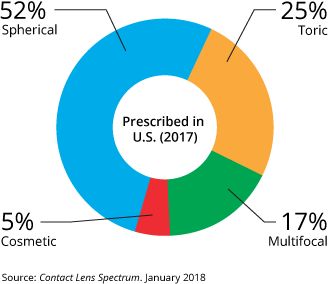
Spherical contact lenses have the same lens power throughout the entire optical part of the lens to correct myopia (nearsightedness) or hyperopia (farsightedness).
Toric soft contact lenses have different powers in different meridians of the lens to correct astigmatism as well as nearsightedness or farsightedness. [Read more about toric contact lenses.]
Multifocal contact lenses (including bifocal contacts) contain different power zones for near and far vision to correct presbyopia as well as nearsightedness or farsightedness. Some multifocal lenses also can correct astigmatism. [Read more about bifocal contacts.]
All of these lenses can be custom made for hard-to-fit eyes. Other lens designs also are available — including lenses fabricated for use in special situations, such as correcting for keratoconus.
More Contact Lens Features
Bifocal contacts for astigmatism. These are advanced soft contacts that correct both presbyopia and astigmatism, so you can remain glasses-free after age 40 even if you have astigmatism. [More about bifocal contact lenses for astigmatism.]
Contacts for dry eyes. Are your contacts uncomfortably dry? Certain soft contact lenses are specially made to reduce the risk of contact lens-related dry eye symptoms. [More about contact lenses for dry eyes.]
Colored lenses. Many of the types of lenses described above also come in colors that can enhance the natural color of your eyes — that is, make your green eyes even greener, for example. Other colored lenses can totally change the color of your eyes, as in from brown to blue.
Special-effect lenses. Also called theatrical, novelty, or costume lenses, special-effect contacts take coloration one step further to make you look like a cat, a vampire, or another alter-ego of your choice.
Prosthetic lenses. Colored contact lenses also can be used for more medically oriented purposes. Opaque soft lenses called prosthetic contacts can be custom-designed for an eye that has been disfigured by injury or disease to mask the disfigurement and match the appearance of the other, unaffected eye.
Custom lenses. If conventional contact lenses don’t seem to work for you, you might be a candidate for custom contact lenses that are made-to-order for your individual eye shape and visual needs.
UV-inhibiting lenses. Some soft contact lenses help protect your eyes from the sun’s ultraviolet rays that can cause cataracts and other eye problems. But because contacts don’t cover your entire eye, you still should wear UV-blocking sunglasses outdoors for the best protection from the sun.
Scleral lenses. Large-diameter gas permeable lenses called scleral contacts are specially designed to treat keratoconus and other corneal irregularities, as well as presbyopia.
Myopia control contacts. Special contact lenses are being developed to slow or stop the progression of nearsightedness in children. [More about myopia control.]
Which Contact Lens Is Right for You?
First, your contacts must address the problem that is prompting you to wear lenses in the first place. Your contact lenses must provide good vision by correcting your myopia, hyperopia, astigmatism, or some combination of those vision problems.
Second, the lens must fit your eye. To do that, lenses come in tens of thousands of combinations of diameter and curvature. Of course, not every lens brand comes in every “size.”
Your ECP is skilled in evaluating your eye’s physiology, and your eyesight, to determine which lens best satisfies the two criteria above.
Third, you may have another medical need that drives the choice of lens. For example, your ECP might pick a particular lens if your eyes tend to be dry.
Finally, consider your “wish list” of contact lens features — colors, for example, or overnight wear.
When you and your ECP decide on the right lens for you, you’ll be given a contact lens prescription. You’ll be able to buy a supply of lenses from your ECP or from the many other outlets that sell contact lenses. [For more on this, please read “Where’s the Best Place to Buy Contact Lenses?”]
Contact Lens Wear and Care
Caring for your contact lenses — cleaning, disinfecting and storing them — is much easier than it used to be.
A few years ago, you would have needed several bottles of cleaning products, and perhaps enzyme tablets, for proper care. Today, most people can use “multipurpose” solutions — meaning that one product both cleans and disinfects, and is used for storage.
People who are sensitive to the preservatives in multipurpose solutions might need preservative-free systems, such as those containing hydrogen peroxide. These do an excellent job of cleaning contacts, but it’s very important to follow the directions for using them. The solution should not come into contact with your eyes until soaking is complete and the solution is neutralized.
Of course, you can avoid lens care altogether by wearing daily disposable contact lenses.
Contact Lens Problems
Trial and error often is involved in finding the perfect lens for you. People react differently to various lens materials and cleaning solutions.
Also, the correct “parameters” of your lens — that is, power, diameter, and curvature — can be finalized only after you’ve successfully worn the lens. This is especially true for more complex fits involving extra parameters, such as with bifocals or toric contact lenses for astigmatism.
If you experience discomfort or poor vision when wearing contact lenses, chances are that an adjustment or change of lens can help.
Today, more contact lens choices than ever are available to provide comfort, good vision, and healthy eyes. If your eyes or lenses are uncomfortable or you are not seeing well, remove your lenses and visit your eye care professional to explore available remedies for contact lens discomfort.
For more information about contacts, visit our contact lens expert at Eyeupdate Eye clinic, 01 Ajuwon junction beside BPNL Filling station, Akute/Ajuwon road, Off Elliot bus stop, Iju-Ishaga, Lagos/Ogun
Contact lenses & solution
Buy prescriptive contact lenses @ N5000 per pair with solution and storage case. Call 08034971582 to place your order

 Contact Lens Material